Showing posts with label UK. Show all posts

Zebra Spider Pictures UK

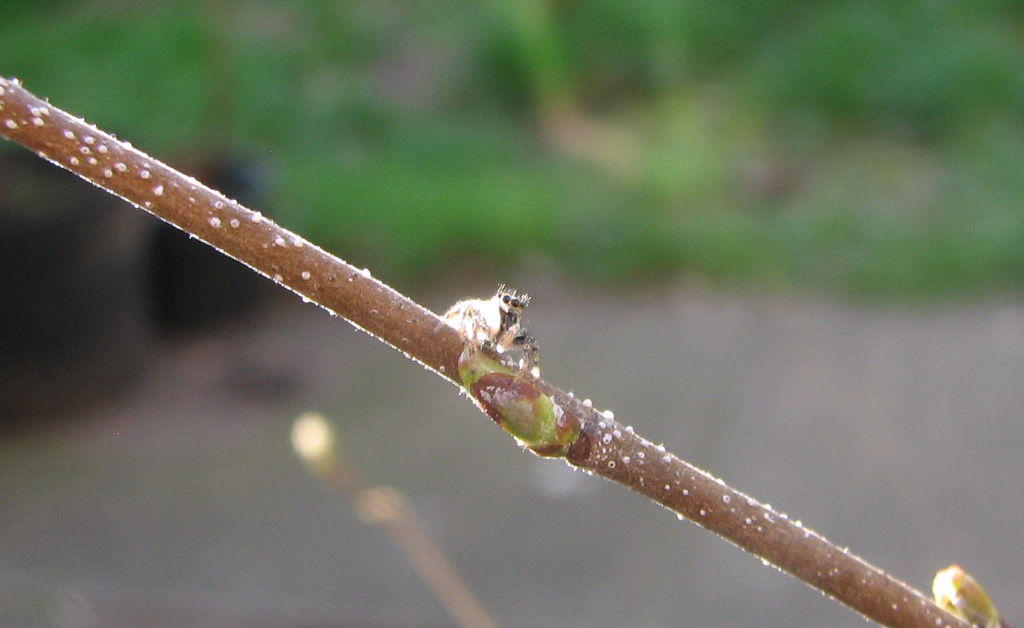
Here are some pictures that I recently took of a Zebra Spider. Such an amazing cute little spider. They are widespread in the UK and possess some of the best eyesight out of all the insects. Incredible vision. As you can see from the images, they have eyes that face forward. They also have other smaller eyes which are at the sides of the bigger pair, helping them see to the sides as well. So in some ways their vision is apparently quite similar to a humans. Amazing.

zebra-spider-picture-uk


Zebra-Spider-Looking-At-Something
Click any photo to enlarge

I-love-the-zebra-spider

macro-jumping-spider-close-up

confused-zebra-spider-looking-sideways
Here it looks curiously confused

Their big eyes and the way they look around makes them appear almost human like. Very curious and friendly. Their movement is very jerky / twitchy, and they can jump. Zebra Spiders do jump frequently. This one was jumping all over the place. it even made a few attempts to land on the camera lens a few times.

On one occasion it made the jump and was on the camera lens! I eventually left it alone when it went and hid under the lip of a plant pot. No doubt one of my favourite spiders. You can see more close up pictures of this spider over on another blog - Still Paused.

How To Grow An Orange Tree From Seed

Take a look online and you will see quite a few methods of how to grow an Orange tree from a seed. From soaking the seeds for a few days, and then placing them in moist see-through bags and placing in a spot that gets some sun etc, to just planting them in some soil and leaving on a window sill somewhere. To be honest, all of these methods work, especially if you put the odds in your favour by planting many seeds. This is a sure way to get some sprouting. Anyway, today I'm going to tell you how I start orange plants from seed. I'm no expert, and I don't own an orange grove (orchard), but I have had considerable germination success from my method.

Baby-Orange-Plant

This is what I do. Eat some Oranges and save the pips (seeds). That's the tasty part. Leave them to dry for a few days, then grab them one by one and peel some of the outer shell (protective layer) off the seed, exposing some of the actual seed inside. On each end of the seed the outer shell goes a little bit pointed, so its not difficult to grab this and peel some off the end. This is to assist the seed to sprout quickly by allowing warmth and moisture to reach the seed more easily, and help it take its jacket off (protective layer) with less hassle. You don't need to peel much off, just enough so that some of the seed is exposed.

Then, just plant them in some wet soil, preferably in slightly acidic soil, at around half an inch deep, and put them in a window that gets some sun. Or better still, outside if the weather is nice and warm like it is here in the UK right now. If the weather is warm there is no need to cover the pot(s) with a see-through plastic bag or cling film. Just keep the soil wet and within a few days you will have some signs germination taking place.

If the temperature doesn't drop too low on the nights in your location, to make them strong and more resilient to the cold weather, leave them outside all night when they are very young (from first germination). I say this because most Orange trees are better suited for warmer tropical climates, they are not really tough enough to withstand the UK's fairly harsh in comparison autumn / winter seasons. So for your trees to stand a better chance of survival in the UK (depending on the variety), you need to get them gradually used to lower temperatures. Of course, in the winter, the UK is far too cold for young citrus / Orange plants / trees to survive.

So give them as much sun as possible through the warmer months, with some colder (but not too cold) nights, get them as big and strong as you can, and then bring them indoors (keep in a window, conservatory or patio) once the temperatures drop really low. Preferably, keep them potted for quite a few years doing this process, and when they reach a good size and maturity, consider planting them outside in a spot that gets the most sunlight.

Don't expect to see fruits straight away though, as Orange trees can take many years to produce fruit if grown from seed. Still, even without bearing fruits, the leaves, and trees in general are beautiful to look at, and fragrant when touched. Everything talked about in this post will also work for lemon trees, too. In fact, most other citrus variety's.

Hound's Tongue - Cynoglossum Officinale

This is just a quick identification post about the Hound's Tongue Plant (Cynoglossum Officinale), which is part of the Borage species. Such a nice plant. Although it is potentially dangerous and considered as a weed to some. The flowers are purple / maroon and the leaves feel very soft to the touch. After the flowering period the Hound's Tongue bears nutlets (seeds).

However, I have not seen them much due to not having a lot to do with this plant. There's also Blue Hound's Tongue (Cynoglossum grande). And I think there are different variations of the purple Hounds Tongue as some examples from other parts of the world look quite different to each other. The picture below is of Hound's Tongue found in the UK (Quickly taken by me).

hounds-tongue-plant-image-uk

Be aware: Hound's Tongue can be poisonous to humans if eaten in big enough quantities, and can also cause dermatitis. It can also be lethal to animals / livestock. Not just a pretty face then! I better go wash my hands. Other than being an attractive plant, or noxious weed as some like to consider them, the best thing about these wildflowers is there smell. Though, it must be an acquired taste because a lot of people say it smells disgusting. Personally I like it. It's quite unique and very alluring. I believe you can buy the flower essence online.

Strange Little Biting Bug UK (Picture)

I come in from being outside in the back garden after messing around with an Alder tree (getting in between the leaves to water it in the pot), and can instantly feel something biting my arm! I look and there's this tiny little yellow bug biting me. It couldn't be anything else other than this bug, as it was in the exact location where the stinging (biting) was coming from. I blew it off my arm and managed to catch it. The bug looks like some kind of hybrid green fly. It's mostly yellow in colour, with a red stripe starting at the eyes and going down the side of the body. It also has white and red Antennae (feelers).  If you look carefully you can see that it does have a mouth needle for piercing through humans skin. Like it did to mine. Strange little bug.

Strange Little Biting Bug UK

I would post the original picture of it caught in a glass but the insect is so small in comparison that its not really worth uploading. But take a look at it magnified approximately 6 - 8 times above. Click the image to enlarge. Weird little insect. Does anyone know what this is? Can you identify it? The bite has not left me with any lasting effects, so I don't think its particularly dangerous. But I'd still like to know if this is just some well-known insect that I've never seen before, or something more exotic and not native to the UK.

Update: This insect has been identified as the nymph of a Campyloneura Virgula. Thanks goes out to the very knowledegable AmandaB over at the nhm.ac.uk natureplus forum for quickly resolving the mystery.

Trending

All Content / Images Copyright © Never Forget Nature
No image can be used without permission